Alabama Bass on the Fly: A Native Fish Worth Knowing

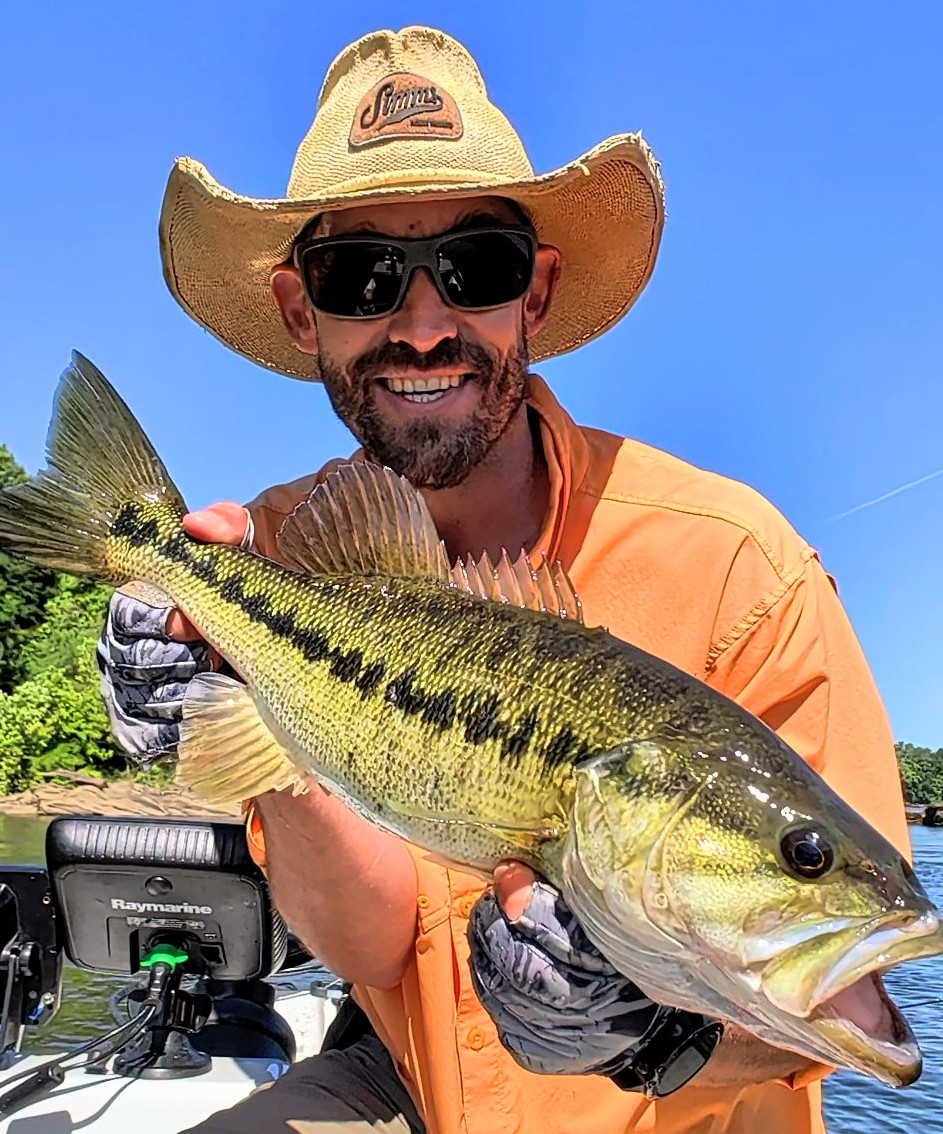
Until a few years ago, I had never heard of an Alabama bass. Like most anglers, I was familiar with largemouth and smallmouth bass, but the other members of the black bass family simply don't get the same attention. It turns out there was a good reason Alabama bass weren't on my radar.
Native to the Mobile Bay basin of Alabama, Georgia and Mississippi, Alabama bass (Micropterus henshalli) were historically considered a subspecies of spotted bass. It wasn't until 2008 that researchers elevated them to full species status and gave them the common name Alabama bass.
My introduction to Alabama bass fly fishing came on the Coosa River, and it didn't take many fish before I realized I'd been overlooking a pretty incredible gamefish.
A Bass With Its Own Personality
Initially, Alabama bass reminded me of fish I already knew. In rocky stretches of moving water, their behavior can feel a lot like smallmouth bass. Move into slower sections of the river and you might find them around downed trees, root systems and brush piles in places that feel more like largemouth habitat.
Scientific research reinforces just how complicated their habitat use can be. A telemetry study of Alabama bass in the regulated Tallapoosa River found seasonal differences in movement, depth, current velocity, substrate and cover use. Habitat use also changed under different flow conditions. That's particularly interesting to me because I'm still learning many of those same relationships on the Coosa.
Over time, one concept has become particularly useful when I'm searching for Alabama bass: contrast.
I look for places where something changes. Rock gives way to vegetation, a gravel shoreline meets bedrock or an isolated tree interrupts an otherwise uniform bank. The same principle applies to the water itself, where fast current meets slow or shallow water drops into something deeper. It doesn't mean an Alabama bass will always be there, but these transitions give me high-value places to investigate.
Season, temperature, flow and light complicate that picture considerably, and I'm still learning how the pieces fit together. That's part of what makes fishing for them interesting. They're mobile predators, not fish I expect to find sitting in exactly the same place every time I visit the river.
Watching the Eat
Finding them is only part of the fun.
On the surface, Alabama bass can absolutely destroy a popper or other surface bug. There's often nothing subtle about it. One second you're working the fly and the next the water erupts as the bass eats and takes off.
Streamer fishing provides a different kind of excitement, particularly because the Coosa can run so clear. Often you can watch the streamer as you retrieve it and see the bass pursue it. Other times the fish seems to appear from nowhere and the fly simply disappears as the bass inhales it.
Then comes the difficult part: don't panic.
Trout anglers in particular have a tendency to react to what their eyes just saw by lifting the rod, or they get anxious and pull the fly away before the bass has fully committed. A strip set is far more effective. Come tight with the line and then hold on because the fish usually has somewhere else it would rather be.
Then Hold On
Alabama bass aren't particularly leader shy, and I commonly fish 10-pound or heavier tippet because once they're hooked, I want enough pressure to keep them away from nearby structure. That heavier tackle also makes their power even more surprising.
A good Alabama bass can double over a six-weight rod and try to rip it out of your hands. They'll bulldog toward structure or simply pull away from whatever has suddenly grabbed hold of them. After that initial battle, they'll often change tactics and head for the surface, jumping and shaking their heads before diving back down for another run.
The smaller fish can launch themselves completely out of the water. The really big ones sometimes have a little more trouble.
I've started calling what they do tail walking. Some of the larger Alabama bass are so thick that instead of completely clearing the water, they come partially out and thrash across the surface before diving back down. Watching a heavy bass do that after you've already fought to keep it out of the structure is one of my favorite sights on the river.
An Unexpected World Record
One day in September 2025, I was prospecting some new water on the Coosa when I came across an outside bend with a series of downed trees. It looked promising, so I started working an articulated streamer through the area.
A bass inhaled it.
As soon as I came tight, the clear water gave me a good look at the fish before it bolted for cover. I knew immediately this one was exceptional. The fight included everything I'd come to expect from a big Alabama bass, including those tail-walking attempts to shake the fly.
Fortunately, a previous experience trying to submit a longnose gar to the International Game Fish Association had taught me to carry the proper measuring board. Once the bass was in the net, I realized I couldn't remember every requirement for submitting a record fish, so I left him resting in the submerged net while I pulled up the IGFA website on my phone.
After getting the measurement and required photographs, I let him recover while I admired him in the little aquarium created by the net basket. Eventually, I lifted the net and watched him swim away.
The fish measured 18.1 inches (46 cm) to the fork of the tail and was subsequently certified as the IGFA All-Tackle Length Fly world record for Alabama bass. The measurement method is worth noting because IGFA measures to the fork rather than the tip of the tail, which differs from the total-length measurements bass anglers commonly discuss.
I've caught several fish since then that were comparable or even longer by the same measurement standard, which has only increased my appreciation for what the Coosa can produce.
Catch Them Where They Belong
The fight alone is enough to make Alabama bass worthy of a fly angler's attention. They'll explode on surface bugs, inhale streamers and test considerably heavier tackle than their size might suggest.
But there's another reason I think they're worth pursuing here.
The Mobile Basin is their native range. These fish evolved in this system, adapting over time to its rivers, currents and habitats. There's something special about pursuing a native species in the environment that shaped it.
For an angler accustomed to chasing more familiar species, Alabama bass offer an opportunity to apply skills you already have to a fish you may not have known existed. You'll read current, work structure, throw streamers and surface flies and recognize pieces of behavior that remind you of other bass.
Then one eats your fly and tries to rip the rod out of your hands.
The fact that you're in for a brawl when you finally connect with one is just an added benefit.


Comments